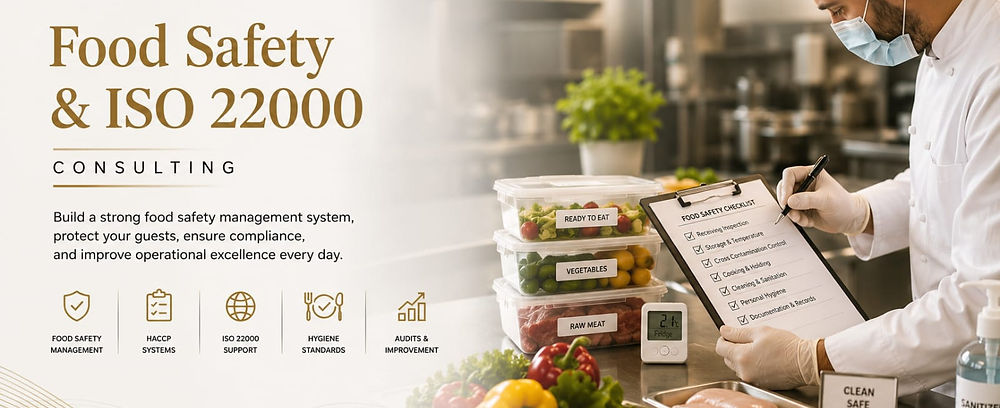
Food Safety & ISO 22000 Consulting
At Chef’s World Consulting, we approach food safety as an essential part of restaurant and hospitality operations, not simply as a set of documents or procedures. Effective food safety requires clear systems, disciplined daily practices, trained employees, proper supervision, and consistent control throughout every stage of the operation.Our consulting approach focuses on helping restaurants and hospitality businesses strengthen their food safety management systems and improve operational practices in line with internationally recognized food safety principles. We review how food is received, stored, prepared, handled, cooked, cooled, held, and served, while identifying operational practices that may create unnecessary food safety risks.Our work may include supporting HACCP-based procedures, food storage organization, temperature control, personal hygiene standards, cleaning and sanitation procedures, prevention of cross-contamination, receiving controls, labeling and date-control practices, operational monitoring, documentation, SOP development, and staff training.We also support businesses seeking to improve their readiness for ISO 22000 requirements by helping them understand and organize the operational systems, procedures, responsibilities, records, and food safety practices required within a structured food safety management environment.Our objective is not simply to create paperwork. It is to help build a practical food safety system that employees can understand, management can supervise, and the operation can apply consistently every day.

HACCP & Food Safety Risk Control
HACCP is one of the most important foundations of an effective food safety management system. In restaurant and hospitality operations, food safety risks can develop at many stages — from receiving and storage to preparation, cooking, cooling, holding, and service. Identifying these risks early and establishing practical controls can significantly reduce the possibility of contamination, unsafe food handling, and operational failures.At Chef’s World Consulting, we help hospitality businesses review their food handling processes and identify areas where biological, chemical, or physical hazards may occur. This includes examining receiving procedures, storage conditions, temperature control, separation of raw and ready-to-eat foods, preparation practices, cooking and cooling procedures, personal hygiene, cleaning and sanitation, and prevention of cross-contamination.Our approach focuses on translating HACCP principles into procedures that can realistically be followed during daily restaurant operations. Critical control points and monitoring requirements should be clear to the people responsible for them, while corrective actions should be practical and properly documented when deviations occur.We also consider how food moves through the operation — from the moment ingredients are received until the finished dish reaches the guest. Understanding this flow helps identify weaknesses that may otherwise remain unnoticed and allows management to establish stronger controls at the appropriate stages.The objective is to help businesses develop a disciplined food safety culture in which employees understand not only what procedures they must follow, but also why those procedures are important. Effective HACCP practices should become part of everyday operations rather than paperwork that is only reviewed during an inspection

Food Storage, Temperature Control & Cross-Contamination Prevention
Proper food storage and temperature control are fundamental to maintaining food safety in any professional kitchen. Even high-quality ingredients can become unsafe when they are stored incorrectly, exposed to unsuitable temperatures, or placed in conditions that allow cross-contamination. For restaurants and hospitality businesses, an organized storage system is therefore an essential part of daily food safety management.At Chef’s World Consulting, we help businesses review how food is received, classified, stored, handled, and moved throughout the kitchen. Particular attention is given to the separation of raw products from cooked and ready-to-eat foods, as well as the organization of meat, poultry, seafood, vegetables, fruits, dairy products, dry goods, and other ingredients according to appropriate food safety practices.Refrigerators and freezers should not simply provide cold storage; they should form part of a controlled system. Temperatures need to be monitored consistently, food containers should be properly covered and identified, and products should be arranged in a way that minimizes the possibility of drips, leaks, or contact between raw and ready-to-eat foods. Storage areas should also remain clean, accessible, and organized so employees can follow established procedures during busy service periods.We also consider stock rotation practices such as FIFO — First In, First Out — together with date labeling, receiving dates, opening dates where appropriate, and expiry monitoring. These practices help improve food safety while also supporting better inventory control and reducing unnecessary food waste.Cross-contamination prevention extends beyond refrigerators and storage rooms. Cutting boards, knives, utensils, preparation surfaces, containers, employee hands, cleaning equipment, and the movement of food through the kitchen can all become potential contamination points if procedures are not clearly established and followed.Our objective is to help create a storage and handling system that is practical for the operation, understandable to employees, and easier for management to monitor. When correct storage, temperature control, labeling, stock rotation, hygiene, and separation practices become part of the daily routine, the kitchen develops a stronger foundation for consistent food safety.

Cleaning, Sanitation & Personal Hygiene Standards
Cleaning, sanitation, and personal hygiene are essential parts of an effective food safety system. At Chef’s World Consulting, we help restaurants and hospitality businesses establish practical hygiene procedures that can be followed consistently during daily operations.Our approach covers food preparation areas, work surfaces, equipment, utensils, refrigerators, storage areas, floors, waste areas, and other points that may create contamination risks. Clear cleaning schedules help define what should be cleaned, how often, and who is responsible.Personal hygiene is equally important. Proper handwashing, clean uniforms, hair restraint, appropriate glove use, and safe food-handling practices help reduce contamination and protect both employees and guests.We also focus on preventing cross-contamination through correct cleaning and separation of cutting boards, knives, utensils, preparation surfaces, and equipment used for different food categories.The objective is to create a clean, organized, and practical hygiene system that employees can follow and management can monitor as part of everyday food safety operations.

SOPs, Monitoring & Food Safety Records
SOPs, Monitoring & Food Safety RecordsEnglish:Effective food safety requires more than good daily practices; it also requires clear procedures, monitoring, and reliable records. At Chef’s World Consulting, we help restaurants and hospitality businesses organize practical Standard Operating Procedures (SOPs) and food safety monitoring systems suited to their operations.These may include refrigerator and freezer temperature records, receiving checks, cleaning schedules, food storage controls, date labeling, hygiene checklists, waste monitoring, and other operational records relevant to the business.Clear documentation helps employees understand their responsibilities and allows management to identify problems, verify procedures, and take corrective action when necessary.Our objective is to build a simple, practical, and manageable documentation system that supports consistent food safety practices and stronger operational control.

Staff Training & Food Safety Culture
A strong food safety system depends on the people who apply it every day. Procedures and records are important, but they are effective only when employees understand their responsibilities and consistently follow safe working practices.At Chef’s World Consulting, we help restaurants and hospitality businesses strengthen staff awareness of food safety principles and operational procedures. Training can focus on personal hygiene, safe food handling, temperature control, storage practices, cross-contamination prevention, cleaning and sanitation, and the correct implementation of established SOPs.We also emphasize the role of supervisors and managers in maintaining standards. Regular observation, clear responsibilities, corrective guidance, and consistent follow-up help transform food safety from written procedures into everyday working habits.Our objective is to support businesses in developing a practical food safety culture where employees understand not only what they should do, but also why these practices are important for protecting guests, maintaining standards, and supporting the operation.

Food Safety Audits & ISO 22000 Readiness
Regular food safety reviews help restaurants identify weaknesses before they develop into larger operational risks. At Chef’s World Consulting, we help restaurants and hospitality businesses review their food safety practices and improve their readiness for structured food safety management requirements.Our review can cover food receiving, storage, temperature control, preparation practices, personal hygiene, cleaning and sanitation, cross-contamination prevention, documentation, SOPs, monitoring records, and staff practices.Where gaps are identified, we help management understand the required improvements and organize practical corrective actions. This may include improving procedures, strengthening documentation, clarifying responsibilities, or providing additional staff guidance and training.For businesses working toward ISO 22000, our role is to support operational preparation and help organize food safety practices and documentation. Certification itself is conducted by an independent accredited certification body.Our objective is to help businesses develop a more controlled, documented, and consistently managed food safety operation that is better prepared for internal reviews, external audits, and future certification requirements.

Building a Sustainable Food Safety System
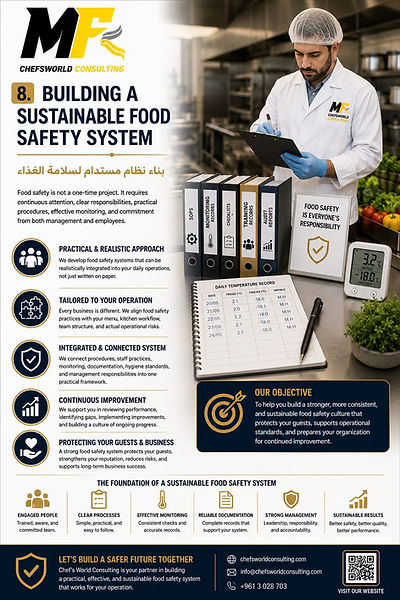
Food safety is not a one-time project. It requires continuous attention, clear responsibilities, practical procedures, effective monitoring, and commitment from both management and employees.At Chef’s World Consulting, our approach is focused on helping restaurants and hospitality businesses develop food safety systems that can be realistically integrated into their daily operations. We aim to connect procedures, staff practices, monitoring, documentation, hygiene standards, and management responsibilities into one practical operational framework.Every operation is different. For this reason, recommendations should reflect the type of business, menu, kitchen workflow, team structure, and actual operational risks rather than relying solely on generic procedures.Our objective is to help businesses establish a stronger, more consistent, and sustainable food safety culture that protects guests, supports operational standards, and prepares the organization for continued improvement.